


May 2010 – SYM has lowered the MSRP on the Fiddle II from $2,268 to $1,969
May 2008 – I have to admit that I came into this review with an attitude. A 50cc 4-stroke… with a 200+ pound reviewer, this is going to be a slow, dull experience. I couldn’t have been more wrong.
Let’s talk about scooters that qualify for “moped” license plates (in Minnesota) for a moment. To get that “moped” plate, a scooter has to be 50cc (usually a little under), 2 horsepower (or less) and no faster than 30 MPH on a flat surface. To achieve this, many scooters come from the factory “restricted” to 2 horses and 30 MPH. There are some 50cc scooters that are NOT restricted by the factory (the Vespa LX50 and the Yamaha C3 come to mind) and those 50cc scooters will get a motorcycle license plate. So what’s the big deal about a scooter that has a moped license plate? I mean, they don’t have pedals so they aren’t really mopeds.
Two things: one does NOT need a motorcycle endorsement on one’s driver’s license to operate them, and they park where a bicycle parks – legally. To a lot of people these are big deals. They want to ride a scooter but they DON’T want to get a motorcycle endorsement. If you live or 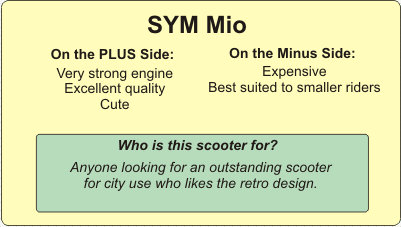 work in an area where parking is at a premium, the idea of being able to park at a bike rack, almost always for free, can be HUGE. I have a couple of friends who work in downtown Minneapolis and they have told me that their “moped” scooters have more than paid for themselves in saved parking fees.
I have ridden quite a few 50cc scooters, and as a general rule, the ones with a 2-stroke engine (fuel and oil mixed together) are going to feel zippier than those with 4-stroke engines. There are some 50cc scooters out there with FABULOUS quality (the Honda Metropolitan for example) but weak (in my opinion) performance from their 4-stroke engines. The SYM Mio has opened my eyes to the 4-stroke 50cc.
SYM (San Yang Motors) is based in Taiwan and has been around since 1961. As those of you who have read some of my other reviews will know, Taiwanese scooters are among the best in world, and SYM only adds to that reputation for quality. The four-stroke engines from SYM have some outstanding features including ceramic coating of the cylinder which means no carbon deposits and a longer life for the motor. The cylinder heads are a one-piece design (as opposed to the more conventional two-piece) which is stronger and makes for better dissipation of heat. SYM uses a four-valve design for enhanced performance.
Speedometer Reading/Speed/Fuel Economy
When I review scooters, I test the accuracy of their speedometers with a GPS unit. The VAST majority of scooters have speedometers that are optimistic (they indicate faster than the actual speed) by 5 to 10 percent. The SYM Mio is as close to spot-on as I have tested. The speedometer indicated 30 MPH when the actual speed was 29.5 and indicated 40 MPH when the actual speed was 39. Hey, didn’t I just say that “moped” licensed scooter were restricted to 30MPH? The SYM Mio that I tested was de-restricted by Blue Cat Motors (the SYM dealer in St. Paul Minnesota). I am not one to recommend disregarding the DMV rules, but I wanted to test the capabilities of the scooter in its “natural” state and Blue Cat was kind enough to oblige. With me (about 210 lbs.) riding it, the SYM Mio topped out at 40 MPH on a flat road. With my wife Beverly (maybe 115 lbs soaking wet) it topped out at 44 MPH. I did most of the riding for this review and I was pushing the Mio fairly hard. OK, the big one – carrying 200+ lbs around at speeds above 30 MPH the Mio still got 98 miles-per-gallon. That’s right, darn near to 100 miles per gallon of fuel even hauling a serious load. That’s the OTHER big advantage to these moped licensed scooters. Don’t need a motorcycle endorsement, easy/free parking AND about 100 MPG. It’s obvious why these scooters are rapidly growing in popularity.
Features
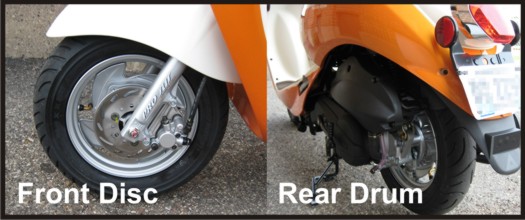
The SYM Mio has some great features (such as the kick-butt engine technology mentioned earlier) including a disc front brake which certainly differentiates it from many other scooters in the high-quality-for-about-$2,000 class. Have a look at the chart to see how the Mio compares with the Honda Metropolitan and the Yamaha Vino.
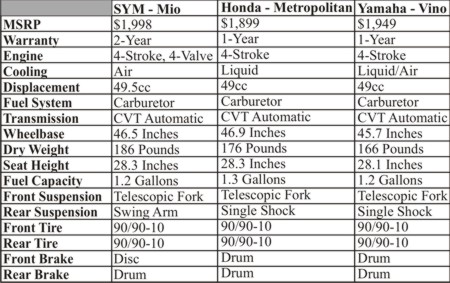
Both the Honda Metropolitan and the Yamaha Vino are much better known than the SYM Mio. The Metro and the Vino enjoy large, nationwide networks of dealers with well-established reputations for quality. That being said, I would purchase a Mio over either the Metro or the Vino as long as I had good local dealer support.
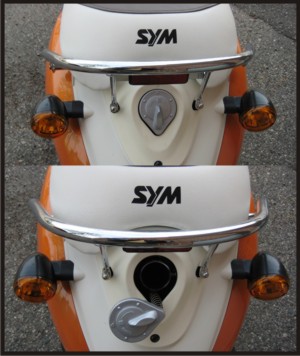
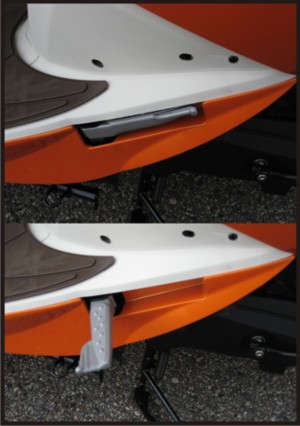
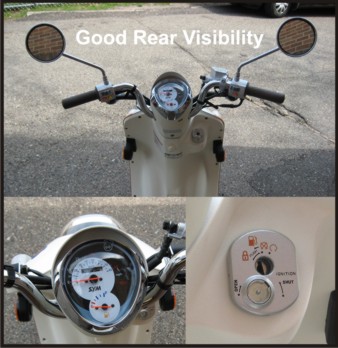
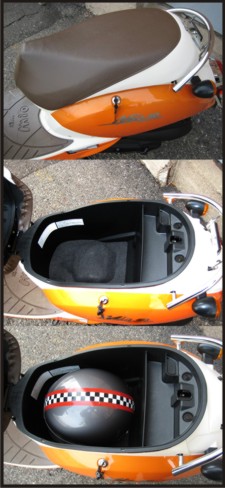
The SYM Mio has very good lighting, front and rear and the dash is easy to read, even in bright sunlight. The controls are simple to use and configured in pretty much the same layout as most other scooters with one exception – the turn signal switch does not have a press-to-cancel feature. That’s my one and only operational complaint about the Mio. Storage under the seat is good, and the seat can be opened with either the key or by means of a release button by the left-hand controls. The fuel door pops open with a turn of the key and was easy to fill, not that you’ll be adding fuel all that often.

 Riding Impressions
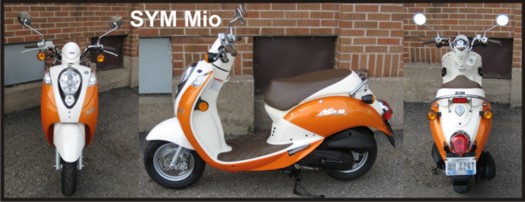
The low seat height makes the Mio easy and un-intimidating for just about anyone to ride. The smallest volunteer I had for this review was 5’ 2” and the biggest was 6’. If you are much taller than that, I don’t think you will be comfortable on the Mio. Everyone who tried the Mio was impressed with the handling, braking and performance.
For a 4-stroke 50cc scooter, I was pleased with the acceleration of the Mio. This certainly doesn’t mean that I consider it “fast” when compared to larger scooters. Pretty much any 100cc – 125cc scooter is going to just walk away from the Mio, but that’s not the point. I mentioned at the onset of this review that I had an “attitude” about 4-stroke 50cc scooters. I’ve ridden several Honda Metropolitans and was always disappointed by their acceleration. The Metro is a great scooter that gets excellent fuel economy and has wonderful build quality, but it was just too slow for me. At my size, I just never felt that a 4-stroke 50cc scooter would be viable for me. After several days riding the Mio I can say that I would consider one for city riding. The brakes are strong, the handling is nimble and the ride quality is surprisingly good for a scooter of this size.
There is greater performance potential from 2-stroke 50cc scooters. One can add performance exhaust systems, play with jetting, and even add a 70cc kit without too much trouble. I know of a few people who have built their 2-stroke 50cc scooters into screaming little machines. Of course they are trading off fuel economy and, to some extent, reliability. There is also the fact that 2-strokes aren’t as clean burning as 4-strokes and this is especially true for performance modified 2-strokes. The SYM Mio is a clean running, high fuel economy, zippy little scoot right out of the box with no modification (other than de-restriction).
Fit and Finish
Every aspect relating to the quality of the SYM Mio appeared to be equal to the best scooters out there. The quality of the components, the paint, the fit of the panels, everything was top notch. It’s obvious that SYM puts a great deal of effort into engineering and building a high quality scooter.
Honda has set a high mark for build quality and from what I have seen, the SYM Mio matches the Honda Metropolitan for fit and finish.
Conclusion
As with any scooter, there are a couple of issues to consider before purchasing. Does the scooter fit you? Is it appropriate for your intended use? Can you get parts and support locally? If the SYM Mio fits you physically and you are looking for high quality, economical and FUN city transportation – get one. Now. As of the writing of this review, Blue Cat Motors (our Twin Cities SYM dealer) is struggling to keep up with demand for the Mio.
May 2010 – SYM has lowered the MSRP on the Fiddle II from $2,268 to $1,969