
October, 2011
“Cool scooter, what kind is it?”
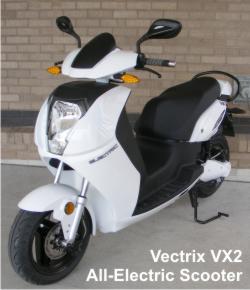
“It’s a new Vectrix VX2 electric scooter.”
“Is it a 4-stroke or a 2-stroke?”
“Neither, it’s all-electric with batteries?.”
“Oh, it’s like a hybrid Toyota Prius then.”
“No, it’s all-electric, you just plug it in to recharge it.”
“Cool, I’ll bet it gets really good gas mileage.”
“Ummm, it doesn’t use ANY gas; it’s a zero emissions electric scooter.”
“So how many cc is the engine? 50?”
“Sigh.”
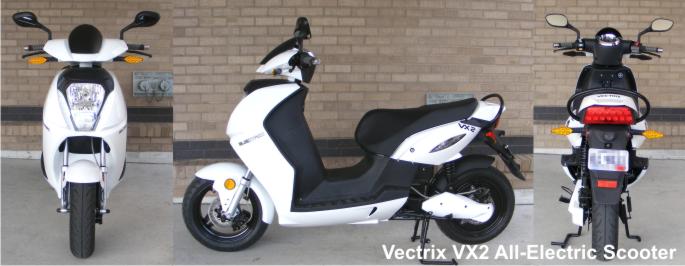
In 2008, I reviewed the Vectrix scooter and had conversations similar to the above every day. The quoted conversation this time was the 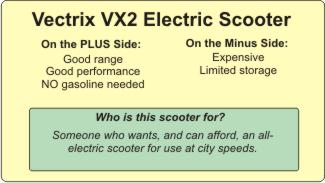 result of riding around on the new Vectrix VX2. It’s been three years since my first Vectrix review, but most people don’t seem to be any closer to “getting” an all-electric mode of personal transportation. In 2009, Vectrix collapsed after losing many millions of dollars. The assets were purchased by Gold Peak (a Hong Kong battery manufacturer and supplier to Vectrix) and Vectrix was able to re-launch. This time around, they are offering the bigger/faster VX1 in two configurations, both with LiFePO4 (Lithium Iron Phosphate) batteries. One has 30AH capacity for $11,995 and the other has 42AH and is priced at $13,995. The new VX2 is smaller, lower speed and has lead acid/silicone batteries with an MSRP of $4,295.
Just like the last Vectrix review, Scooterville in Minneapolis Minnesota has stepped up to the plate yet again and provided us with a new VX2 to play with for a few days. Several people gave it a try and it was regular daily commuting transportation for a few days. No special treatment. No special routes, just the regular drive only limited to speeds of 40MPH or below (no highway).
Speedometer Reading/Speed/Range
I picked up the Vectrix VX2 fully charged and immediately bolted on a GPS and started riding. The speedometer is biased to miles, but the digital odometer display was in kilometers. I would image that there is a way to alter this, but couldn’t figure out what that way might be. The speedometer was 7% optimistic: at a GPS speed of 30 MPH, the indicated speed was 32 MPH. The top speed I was able to get from the VX2 was 38 MPH (GPS) which the speedometer indicated as 41 MPH. The odometer was very slightly optimistic with 28.0 km indicated when 27 km was the actual distance traveled. Now for the biggie – range.
Even before they ask how fast it is, most people ask about how far the scooter will go when they hear it is battery powered. People really seem to have hybrids on the brain as most kept asking how I started the engine to charge the battery. I did have to interrupt my range testing as I experienced a flat tire during the first run (quickly repaired by Scooterville). Eventually, I was able to commit a pleasant Sunday to range testing. In normal riding, nothing special, I managed to cover 49.6 miles before the Vectrix gave up (79.8 kilometers). 46 of those miles were at normal operation and speed with the last 3.6 miles being at reduced speed. The VX2 kept going at about 20 MPH before falling to 10 MPH and then giving up. MANY warnings were flashed at me on the display, but I ignored them and just kept riding. With less of a load (220 pounds of me, that’s 100 kilograms in case you were wondering) I would expect a touch more than 50 miles. I would say 40 – 45 miles is the safe, effective range.
It took about five hours to recharge the batteries and based on Xcel Energy’s current rates for power, cost me about 56 cents in electricity. Close to a penny-per-mile. If you have a 20 – 30 mile round trip commute on city streets the Vectrix VX2 will EASILY do it for chump change in power costs.
Features
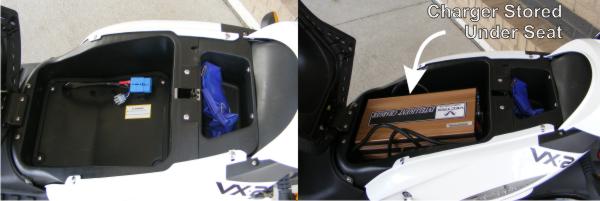
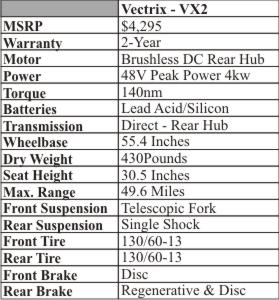 The Vectrix VX2 is similar to most conventional gas scooters in control layout and riding with the exception of weight. At 430 pounds, it’s twice the weight of most 50cc scooters. The VX2 has lead acid/ silicon batteries that are expected to last three years in normal use. Being lead acid batteries, they should be very inexpensive to replace, maybe a couple hundred bucks. Those batteries get power to a 4 kilowatt, brushless, DC rear hub motor to provide locomotion. An “intelligent charger” is provided with the scooter that can plug into any standard 120 volt outlet. It is stored under the
 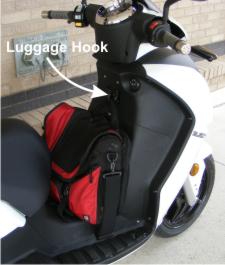 seat and takes up pretty much all the available space there. If one plans on carrying one’s charger with the scooter (a very good idea), then the underseat storage is not available for anything else. There is a luggage hook and a reasonable floorboard space to carry items that way. I have been told that a rear luggage rack is also in the works, so mounting a trunk would be possible. Of course a lot of scooter riders carry whatever they need to on their person in the form of backpacks and messenger bags.
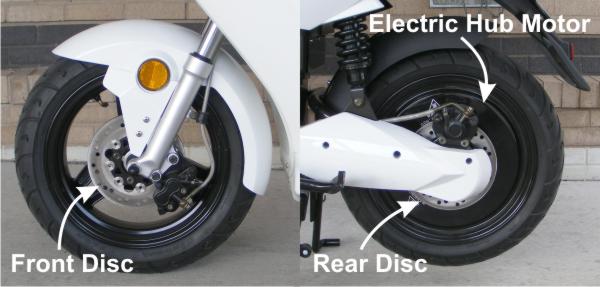
Front suspension is a conventional telescopic fork and the rear is a single shock. There are disc brakes front and rear not that one will need them often. The Vectrix VX2 utilizes a regenerative braking system similar to the system in its big brother. We’ll get into the functionality of that system in a minute, but it works well enough in slowing down the scooter that utilizing the conventional disc brakes is only necessary for quick stops and to hold the scooter in position on an incline or decline.
The dash of the VX2 is a simple, round display. The Analog speedometer is biased to miles-per-hour with kilometers-per-hour on an inner ring. Just below center is a digital display that includes text messages and a sort of gauge indicating how much battery power remains. The 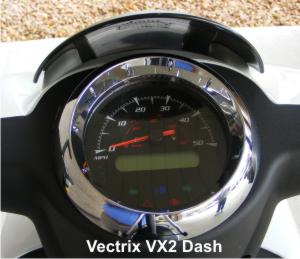 lower part is made up of indicator/warning lights for turn signals, high beam, charging and the like. I found the power gauge to be inaccurate as it would jump to “full” when the regenerate brakes were in use and fluctuate wildly during riding. At a steady 30 MPH (or so) seemed to be the only time it gave anything like an accurate reflection of remaining battery power. The display does give warning when power is low and instructs the rider to turn off the scooter when the limits of the range are near. For myself, I would take note of the odometer and keep my riding on a single charge to 70 kilometers or less.
The headlight was bright and the high/low beam switch is in the conventional position on the left-hand control. The rear lights and turn signals are LED. The turn signal switch is push-to-cancel and also on the left-hand control. The horn was adequate so far as volume is concerned. There is an engine stop switch on the right-hand side, but no starter button. More on that in a minute.
Riding Impressions
Time to hit the road. If you’ve read the 2008 Vectrix review, you probably already know the starting procedure. Turn the key to the “on” position, grab and hold the left brake lever, grab the right brake lever. The turn signals flash and a message on the digital display lets you 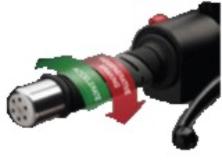 know you’re ready to go. That’s it. No noise. No vibration. Nothing that one might “feel” to indicate the difference between running and not running. Just twist the throttle and you’re moving – forward or backward. Yes, there is a “reverse” on the VX2. From a stop, twist the throttle away from you and the bike backs up. Twist the throttle toward you (conventional operation)and the bike goes forward. When you are in motion, twisting the throttle away from you engages the regenerative braking. This takes some getting used to at first. After just a few miles of riding, I found it not only comfortable but effective. By planning for a longer stopping distance in normal traffic, I didn’t need to utilize the conventional disc brakes at all. For quick stops and to hold the scooter in position on a hill, just use the brake levers normally. The brakes are good, though the weight of the scooter is apparent when braking.
The 430 pounds of the Vectrix VX2 are also apparent in the handling and ride. It may LOOK like a small scooter, but it isn’t. The front and rear suspension are working hard and the rider feels it. The VX2 takes some effort to turn and one feels every rough patch in the road. Firm and very nearly rough is what I would say about the ride. As it happens, I like a firm riding scooter.
Acceleration from a stop is sort of a two-stage affair. Unlike it’s bigger brother, the VX2 doesn’t just launch one from a standstill, there’s a smooth engagement of the hub and then that wonderful electric acceleration. From 10MPH to 30MPH the VX2 is much quicker than a comparable small gas-engined scooter. My regular commute includes a pretty steep hill and the VX2 held 30MPH even with 220 pounds (me) on it. On smaller hills, no loss in speed was noticed.
The seat is firm and wide. The floorboards are also wide. Vectrix says the seat height is 29.9 inches. I measured with a square and a level and got 30.5 inches. Add the “spread” necessitated by the width and I couldn’t touch flat-footed (30 inch inseam). When my wife Beverly rode the VX2, see was also just barely flat-footed (30 inch inseam) in shoes with heels. This wouldn’t be a big deal at all except for the weight of the scooter. Bev felt a little “skittish” at very low speeds. As soon as one is at, oh, say, 10 MPH, the weight is much less noticeable in the balance of the scooter.
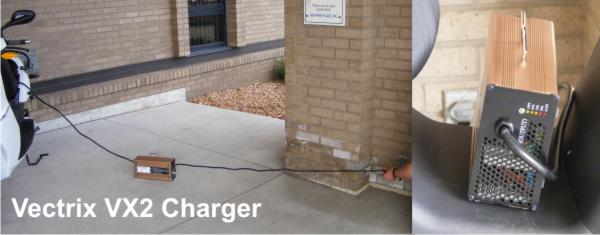
I could easily make the round trip to my office with no concern about battery power. It’s about 20 miles round trip for me. Still, I did ask if I could plug in at the office and the building management was just fine with it. They even let me park near the entrance which isn’t exactly kosher. A cute all-electric scooter will do that to people. The charger has indicator lights for percentage of charge. I didn’t have my test equipment with me at the office, so I don’t know exactly how long it would take to fully re-charge after the 10 mile one-way trip, but I’m guessing it wouldn’t be long.
Fit & Finish
The Vectrix VX2 has good fit and finish. The plastic panels fit well together. Not like a Honda or Kymco, but good. As I mentioned, the foam in the seat is very firm. The material covering the seat feels a little thin. The switches functioned just fine, but they felt a little less-than-perfect when compared to a really world-class scooter. I’d just come off two reviews of Kymco 300cc scooters and could feel the difference. I’m not saying that there was anything “bad” about the Vectrix, but it’s not the top of the heap either. I did go over the body panels and check tolerance when the colored and black plastic panels met. The assembly was well done.
Conclusions
I was impressed with the performance and range of the Vectrix VX2. It’s more fun to ride than a lot of comparable city (30 MPH) scooters. The electronic technology works well and the build quality is good. Would I buy one? Probably. Should you buy one? Maybe. To me, it depends on why you are considering an electric personal vehicle. If it’s for purely economic reasons, than the Vectric VX2 is not a good choice. Let’s look at a three year cycle including acquisition. Out the door, with freight, prep, taxes and fees, a $4,295 (here in Minnesota) would be about $5,000. A 2012 Genuine Buddy 50cc Scooter is about $2,500 out the door. The Vectrix is going to cost about a penny per mile while the Buddy is going to get about 80 MPG. Let’s be kind to the Vectrix and tough on the Buddy. We’ll assume that the cost of electricity is flat and that gas is $4.00 per gallon. The Buddy will also need about a liter of 2-stroke oil every 600 miles at $15 per liter. The Buddy will also have maintenance costs of about $100 per year while the Vectrix may not need any maintenance. Insurance is likely to be about the same and additional riding equipment like a helmet, jacket, gloves, etc. would be about the same for either scooter. Let’s assume that you can ride 5,000 miles per year on your scooter (most people in Minnesota ride a lot less than that in a year). Now we add everything up and divide by 15,000 (three years of miles). The VX2 plus electricity would be $5,150. The Buddy plus gas plus oil plus maintenance would be $3,925. In three years, the Vectrix cost 34 cents per mile and the Buddy cost 26 cents per mile. If gas is less than $4.00 per gallon and you drive less than 5,000 mile on your scooter in a year, the numbers fall even more in favor of the Buddy. You shouldn’t buy a Vectrix to save money.
You SHOULD buy a Vectrix to not burn gas. OK, in fairness, I haven’t researched this – but I find it hard to imagine that even coal-burning power generation would create nearly as much pollution as burning gasoline. The Vectric VX2 is just so darn efficient in its consumption of electricity that the pollution put into the air to make the tiny amount of power it needs should be very low. If you get your power from hydro (or solar, or wind) you will be making a significant positive impact by riding your Vectrix as opposed to driving your car. Of course at 34 cents per mile over three years, the Vectrix VX2 is still much less expensive than most any car….
Thanks Bob Hedstrom of Scooterville for facilitating this review.
David Harrington